You've narrowed down your list of schools, been to the open days, and found one that ticks all the boxes. But is your home address standing between your child and a place at their first-choice school?
When house hunting, many South African parents will consider school feeder zones as much as security, property prices, and the commute to work. It's not just about the convenience of a quick morning school run; for some schools, your postal code can play a massive part in whether your child gets accepted or not.
But how do school feeder zones actually work in South Africa? Does living closer to a school improve your child's chances of getting in? And is it worth moving for? This guide will tell you everything you need to know before making the decision.
What are school feeder zones in South Africa?
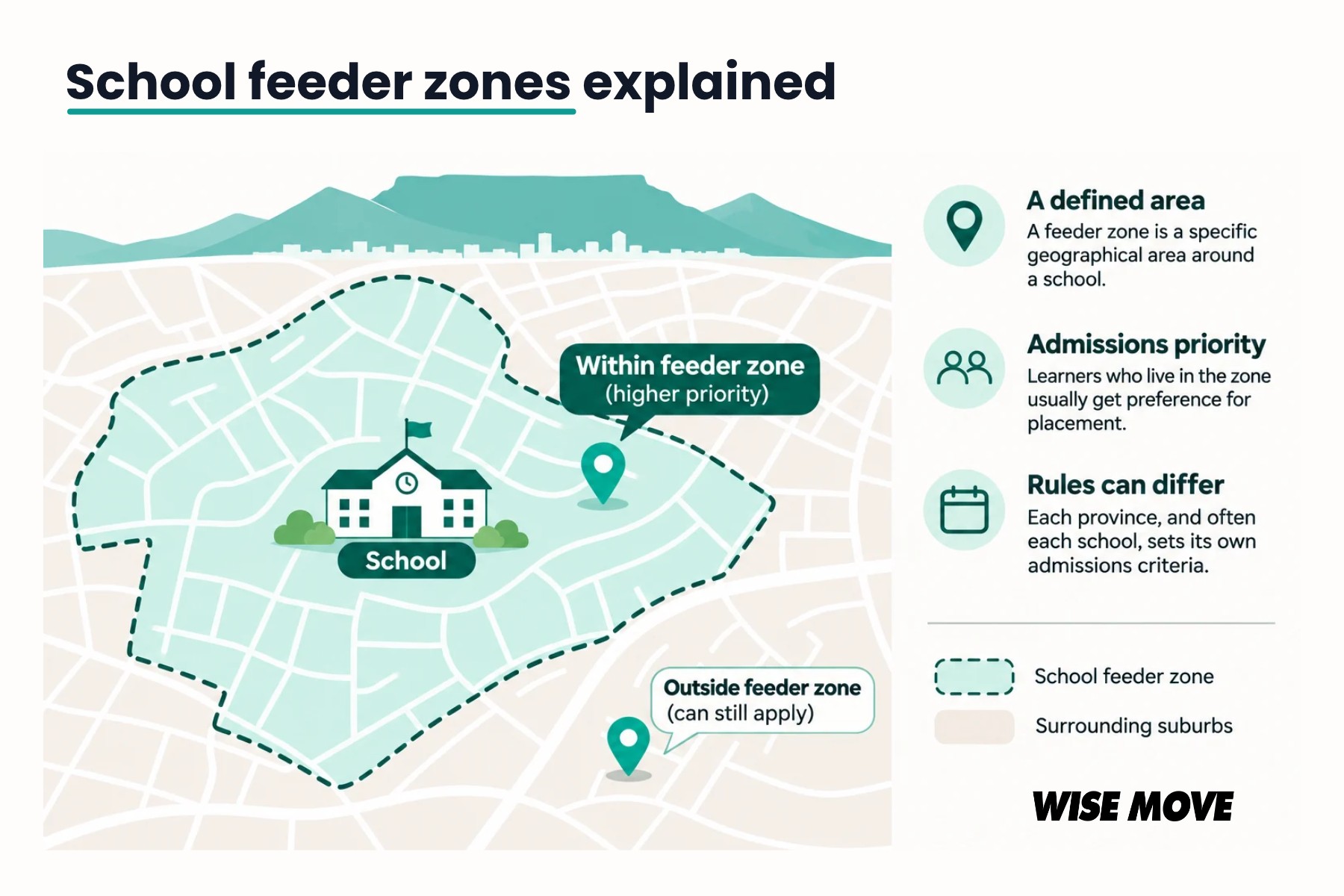
A school feeder zone, or catchment zone, is a designated geographical area surrounding a school. Some South African public schools will prioritise applications from children who live in this area (or, in some cases, if the parent works in the area).
What does this mean for parents? Where you live could directly impact your child’s chances of getting admitted to their chosen school.
But it isn’t as simple as blindly accepting those within the feeder zone and declining those outside the borders. Each school has their own admissions criteria and often take other factors into consideration, including:
- Academic and extracurricular performance: How well does your child perform and participate in the school?
- Siblings: Do any of your other children currently attend the school?
- Legacy: Did one of your parents attend the school?

What is the purpose of school feeder zones?
School feeder zones serve a very specific purpose, especially in South Africa, where access to education is critical. The aim of school feeder zones is to:
- Prioritise access to local schools: Give children living within designated areas greater opportunities to attend schools in or near their communities.
- Reduce commuting times and transport costs: Encourage learners to attend schools closer to home, making education more accessible and affordable for families.
- Manage demand for school places: Help education departments allocate learners to schools with limited capacity.
- Strengthen local communities: Encourage closer relationships between schools, families and their surrounding neighbourhoods.
Does the feeder-zone system work?
As with everything in South Africa, it’s complicated. In some places, it can create elite pockets where only those who can afford to live in affluent areas can attend the best schools.
However, in Gauteng, revised feeder zones aim to redress apartheid-era spatial inequalities and improve access to quality education for learners from historically disadvantaged communities.
How do school feeder zones work across South Africa?
Not all South African schools use feeder zones, and those that do don't necessarily follow the same system. How much your address matters depends largely on the province and the individual school.
Here's how it works in different parts of South Africa.
Gauteng
Gauteng has a well-established, province-wide school feeder-zone system. The Gauteng Department of Education (GDE) manages Grade 1 and Grade 8 applications through its centralised online admissions portal, where parents can also check which school feeder zones cover their address.
Under the GDE's published placement criteria, applications are prioritised in the following order:
- Home address within the school's feeder zone.
- Qualifying sibling or previous-school applications.
- Parent's work address within the school's feeder zone.
- Home address within 30 km of the school.
- Home address more than 30 km from the school.
Placement is still subject to the school's available capacity.
Check out our guide to the top schools in Johannesburg and Pretoria for everything parents need to know.
Western Cape
The Western Cape Education Department (WCED) hasn't declared official school feeder zones. However, this doesn't mean your address doesn't matter. It just means parents have to do a bit more digging into individual schools' admissions policies.
For the provinces that don't have an official feeder-zone system, there are typically three approaches you might come across:
- School-defined feeder areas: Schools, such as Parel Vallei High School and Monte Vista Primary School, give preference to learners residing within specified geographical areas.
- Residential proximity: Schools, such as Westerford High School, consider how close you live or whether you're within a reasonable commuting distance, without defining strict feeder-zone boundaries.
- No explicit geographical preference: Schools, such as South Peninsula High School, don't specifically list residential proximity among their published selection criteria.
Free State
The Free State Department of Education also recognises feeder-zone priority in its admissions guidance. Learners living within a school's feeder zone receive preference, although those living outside it can still apply.
Other provinces
Elsewhere in South Africa, check with the relevant provincial education department and your preferred school to establish whether geographical admissions criteria apply.
What about private schools?
Private schools (also called independent schools) generally don't follow the public-school feeder-zone system. They set their own admissions criteria, which may or may not take residential proximity into account.
How do school feeder zones work in real life?
Let's compare two well-known South African public high schools to see how differently your home address can influence admission.
| School |
Pretoria High School for Girls, Arcadia, Pretoria |
Parel Vallei High School, Somerset West |
Westerford High School, Rondebosch, Cape Town |
| System |
Official provincial feeder zone |
School-defined feeder area |
No defined feeder zone |
| How it works |
The school follows the GDE's official feeder-zone system for Grade 8 day-school admissions. |
The school gives preference to learners residing within its own defined geographical boundaries. |
The school explicitly states in its admissions policy that it doesn't have a specific feeder zone. |
| What matters |
Whether your exact home address falls within the school's designated feeder zone. |
Whether you live within boundaries defined by landmarks such as the Lourensford River and the Helderberg foothills. |
Whether you live within a reasonable commuting distance of the school. |
| What parents should know |
If you're house hunting in nearby Brooklyn or Hatfield, don't assume the whole suburb qualifies. Check the feeder-zone map on the school's admissions page. |
Not every Somerset West address necessarily qualifies. Check the boundaries in the school's admissions policy. |
Living in the surrounding Southern Suburbs or attending a feeder primary school doesn't guarantee your child a place. |
Three public schools, three different approaches. At each school, where you live matters, but how much it matters differs considerably.
My own example: My family moved from Fish Hoek to the Southern Suburbs when I was in Grade 6 to move closer to Cape Town’s top public high schools and increase my chances of getting admitted, on top of getting good grades and meeting the additional requirements.
How can you check which school feeder zone covers your address?

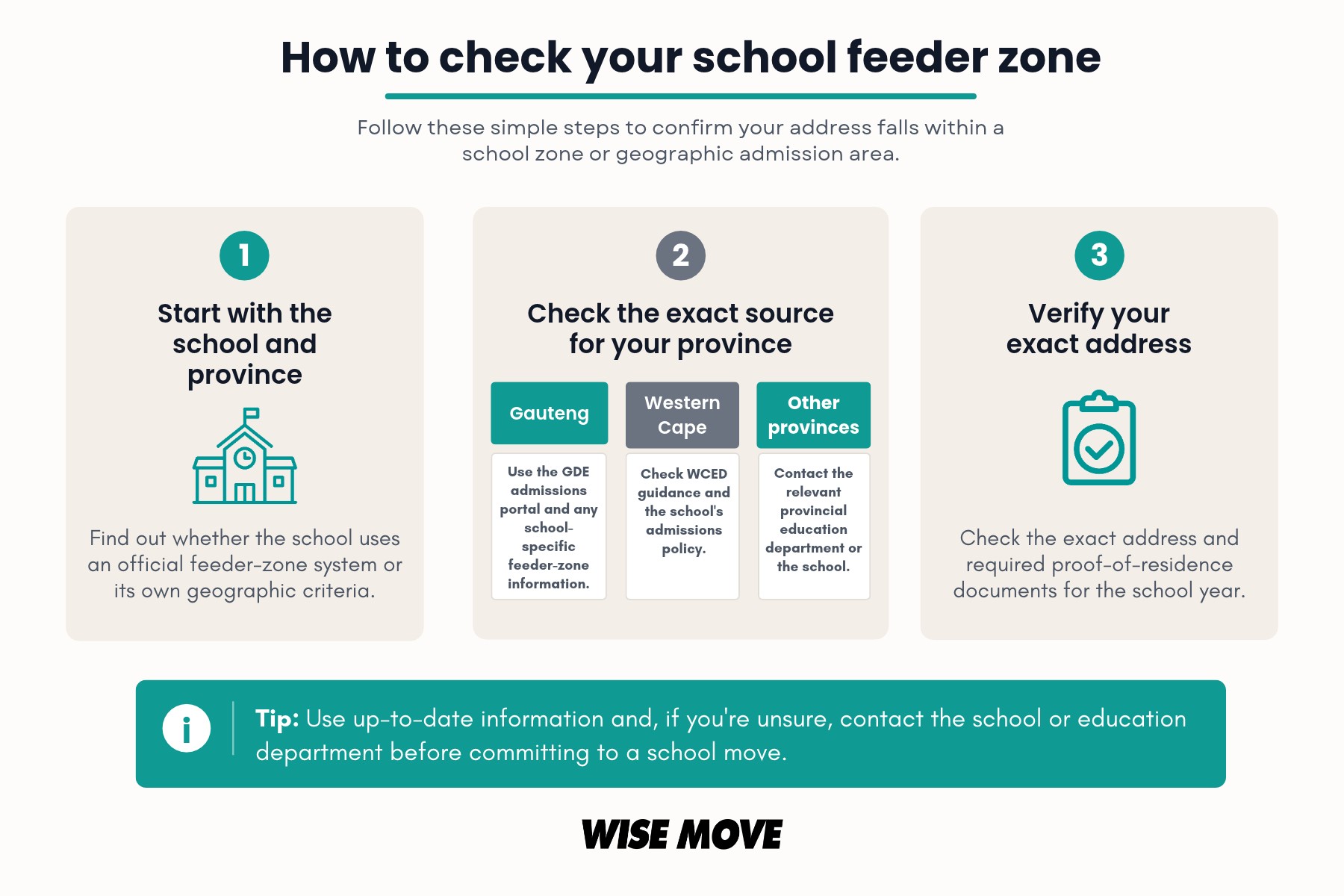
There's no single school feeder-zone map for South Africa, so where you look depends on the province you're in and the school you're applying to.
Here's how to check:
- Gauteng: Use the GDE online admissions portal to identify schools whose feeder zones cover your address. Some schools also publish feeder-zone maps on their websites.
- Western Cape: Consult the WCED admissions guidelines and your preferred school's admissions policy to establish whether geographical preferences apply.
- Other provinces: Contact the provincial education department or the school's admissions office to find out how your address is considered.
Always verify your exact street address, check the proof-of-residence requirements and use information relevant to the year your child will start school.
If you're house hunting, don't rely solely on an estate agent's claim that a property falls within a sought-after school feeder zone. Confirm it directly with the school or education department before signing anything.
Should you move closer to your child's preferred school?
If you've set your heart on a particular school but live outside its feeder zone, moving might be one of the most effective ways to improve your child's chances of admission. But it's a big financial and lifestyle decision, so when is it actually worth it?
Moving into a school feeder zone makes the most sense if:
- Your address could make a meaningful difference to admission: Confirm how much priority the school gives to families living within its feeder zone.
- You have younger children: Your family could enjoy living in the area for many years to come.
- There are several good schools nearby: You're not investing in a neighbourhood for just one school. If it doesn’t work out, you have other options.
- The move makes financial sense: Weigh higher housing costs against potential savings on school transport and the long-term value of the property.
Buying in a sought-after school feeder zone can also be a sound property investment, as sustained demand from families helps support property values during market downturns.
What should you check before moving for a school?
Found a great house near your first-choice school? Before signing a lease or putting in an offer, work through this checklist:
-
Check the school's admissions policy: Does it have a defined feeder zone or simply give preference to learners living nearby?
-
Verify both addresses: Would your new address actually give you greater admissions priority than your current home or work address?
-
Get your timing right: When do applications open and close, and when must you provide proof of your new address?
-
Get your paperwork in order: Proof-of-residence requirements vary, but may include a municipal rates account, signed lease agreement or affidavit. Always provide genuine, up-to-date information.
-
Have a Plan B: Research alternative schools in the area in case your first choice is full.
-
Think beyond the school run: Consider housing costs, your commute to work and whether the neighbourhood suits the whole family.
A good move should work for everyone, not just the school-going members of the family.
Making the Wise Move for your family

Whether you're moving into a school feeder zone or simply looking to make the daily school run a little easier, Wise Move can help get your family settled into the right neighbourhood.
Between sorting out school uniforms, buying stationery and helping your children adjust to a new school, you've got enough on your plate. Book a trusted moving team to take care of the heavy lifting while you focus on getting your family settled for the new school year.
FAQs about school feeder zones in South Africa
Can I apply to a school outside my feeder zone?
Yes, but applicants living within the school's feeder zone may receive priority.
How far do I need to live from a school to qualify?
There's no nationwide distance requirement. Check the school's specific feeder-zone boundaries or admissions policy.
Can I use my work address for school applications?
Yes, in provinces like Gauteng, although residential addresses within the feeder zone receive higher priority.
Does moving into a feeder zone guarantee placement?
No. Admission still depends on school capacity and other applicable admissions criteria.
Do private schools have feeder zones?
Generally, no. Private schools set their own admissions criteria, which may or may not consider residential proximity.
What's the difference between a feeder zone and a feeder school?
A feeder zone is a geographical area linked to a school's admissions criteria. A feeder school is typically a primary school that feeds learners into a particular high school, although attending it doesn't guarantee admission.
What happens if I move after applying?
Notify the school or education department and submit updated proof of residence. Your admissions priority may not change.